
PICT¤
A differentiable, GPU-accelerated multi-block PISO solver with CUDA for PyTorch, built for simulation-coupled learning in fluid dynamics.
PICT solves the incompressible Navier–Stokes equations with the PISO algorithm on the GPU and is fully differentiable. Its fields are plain PyTorch tensors and every solver step supports autograd, so you can put neural networks inside the simulation and train them by backpropagating through many solver steps. The paper uses this to train correctors for coarse 2D simulations and a 3D sub-grid-scale model for turbulence that is learned from flow statistics alone.
- Validated PISO solver on flexible, deformed multi-block domains in 2D and 3D: O-grids, C-grids, wall-refined channels
- Seamless PyTorch integration for AI, deep learning and neural networks
- Fully differentiable, with hand-written backward CUDA kernels and adjoint linear solves
- Modular CUDA operators for efficient simulation at training and inference time
Installation¤
git clone https://github.com/tum-pbs/PICT.git && cd PICT
conda create --name pisotorch --file environment.txt
conda activate pisotorch
pip3 install torch torchvision torchaudio --index-url https://download.pytorch.org/whl/cu128
conda install cuda-toolkit=12.8 -c nvidia/label/cuda-12.8.1
cd extensions && python setup.py install && cd ..
Requires Linux and an NVIDIA GPU. 👉 Full installation guide, including tested PyTorch/CUDA versions and troubleshooting.
PICT Paper¤
Quickstart¤
A lid-driven cavity in a few lines, and an optimization through the solver:
import torch
import PISOtorch, PISOtorch_simulation
import lib.data.shapes as shapes

dtype = torch.float32
grid = shapes.make_wall_refined_ortho_grid(32, 32, wall_refinement=["-x", "+x", "-y", "+y"], base=1.10)

domain = PISOtorch.Domain(2, torch.tensor([1e-3], dtype=dtype), name="Cavity",
                          device=torch.device("cuda"), dtype=dtype, passiveScalarChannels=0)
block = domain.CreateBlock(vertexCoordinates=grid.cuda().contiguous(), name="Cavity")
block.CloseAllBoundaries()                                         # no-slip walls
block.CloseBoundary("-y", torch.tensor([[1.0, 0.0]], device="cuda", dtype=dtype))  # moving lid
domain.PrepareSolve()

sim = PISOtorch_simulation.Simulation(domain=domain, time_step=0.25, substeps="ADAPTIVE",
                                      non_orthogonal=False, log_dir="./test_runs/cavity", log_interval=10)
sim.run(iterations=100)                                            # Re = 1000, 25 time units
# recover an unknown forcing from a target flow by backpropagating through the solver
# domain: a prepared PISOtorch.Domain, here the periodic 2D channel of the "Learning a Forcing" example
# target_velocity: the velocity of a reference run with the unknown forcing
forcing = torch.zeros([1, 2], device="cuda", dtype=dtype, requires_grad=True)
optimizer = torch.optim.SGD([forcing], lr=1e-2)

for step in range(20):
    opt_domain = domain.Copy()
    opt_domain.getBlock(0).setVelocitySource(forcing)
    opt_domain.PrepareSolve()
    PISOtorch_simulation.Simulation(opt_domain, time_step=0.1, non_orthogonal=False,
                                    differentiable=True, log_images=False).run(3, log_domain=False)
    loss = torch.sum((opt_domain.getBlock(0).velocity - target_velocity) ** 2)
    loss.backward()
    optimizer.step(); optimizer.zero_grad()
    opt_domain.Detach()
See Learning a Forcing for the complete example.
Run scripts from the repository root, which contains PISOtorch_simulation.py and lib/. The examples go much further, from vortex streets and airfoils to learned turbulence models.
Example gallery¤
Benchmark flows from the sample scripts, simulated with PICT and rendered for this website. Each example page names its source script and walks through the code of the setup.
-
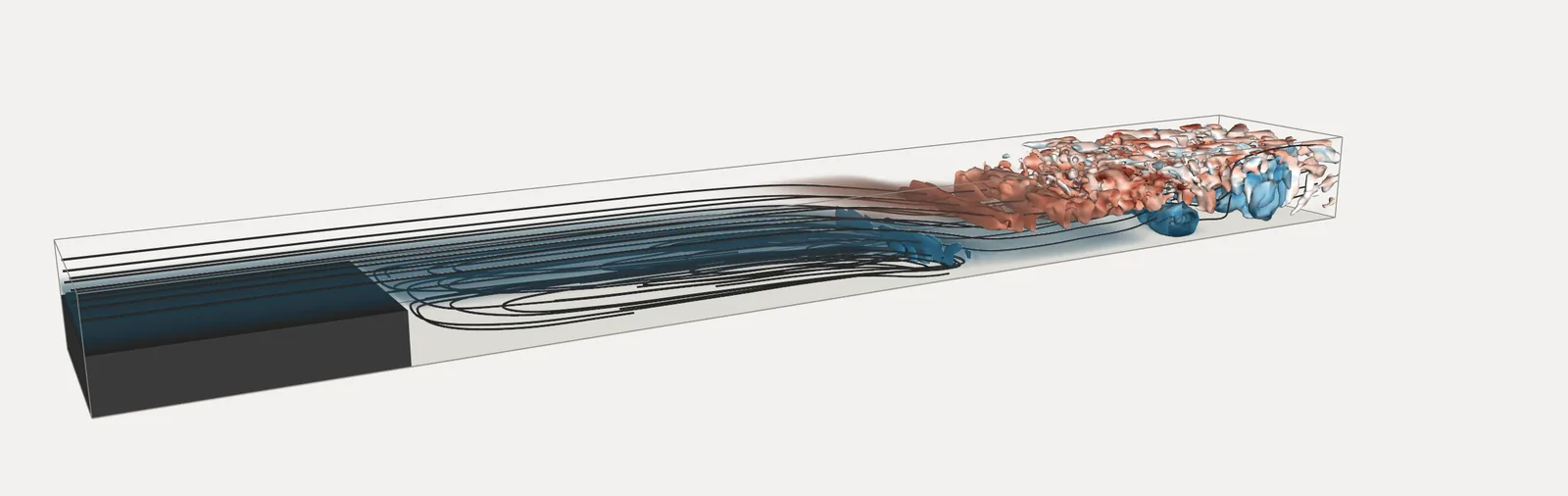
Backward-Facing Step · 2D and 3D, Re = 1400
-
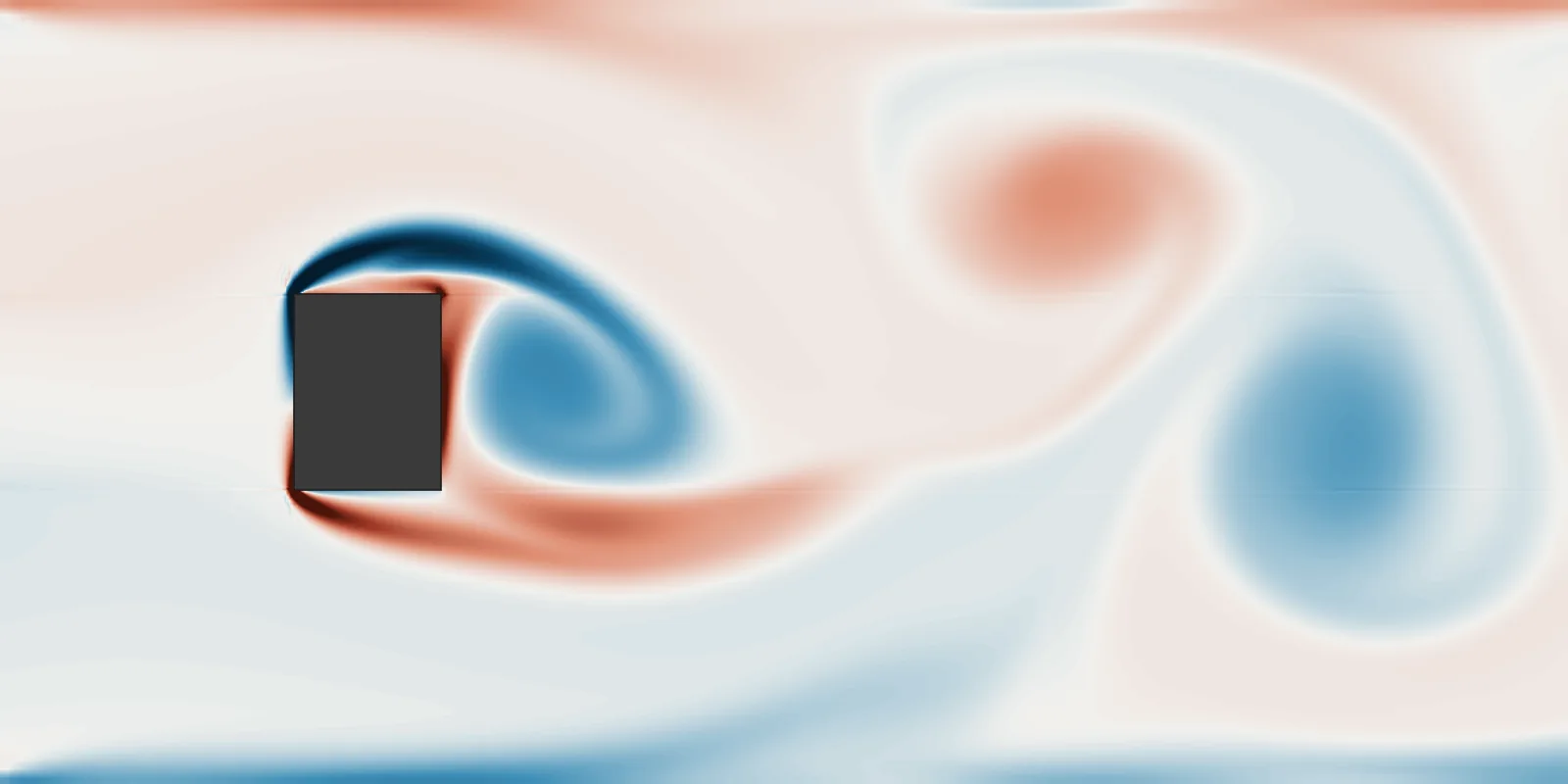
Kármán Vortex Street · 8 blocks, Re = 600
-
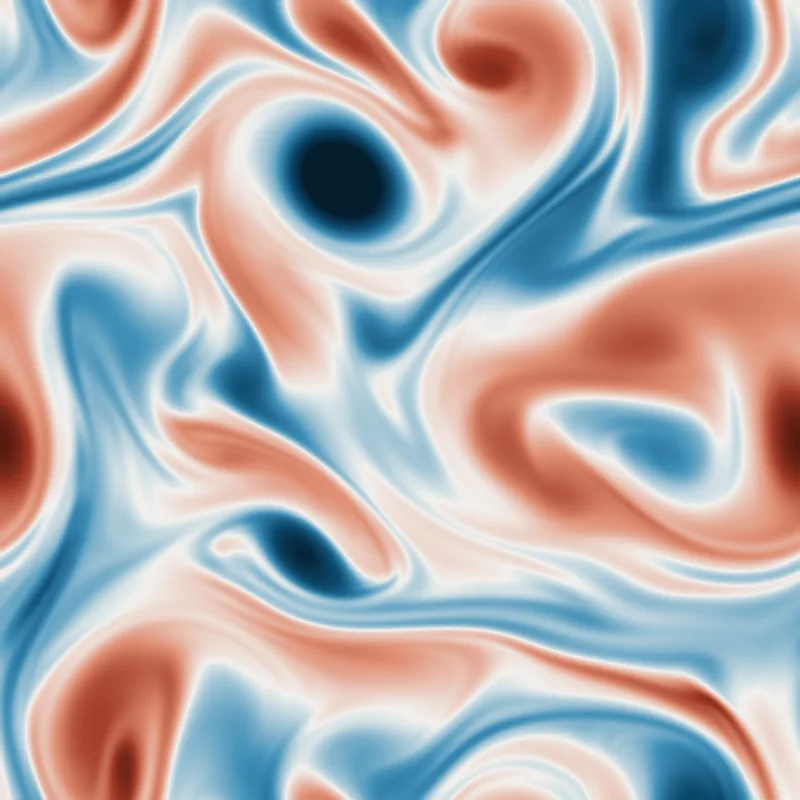
Decaying & Kolmogorov Turbulence · periodic 2D and 3D
-
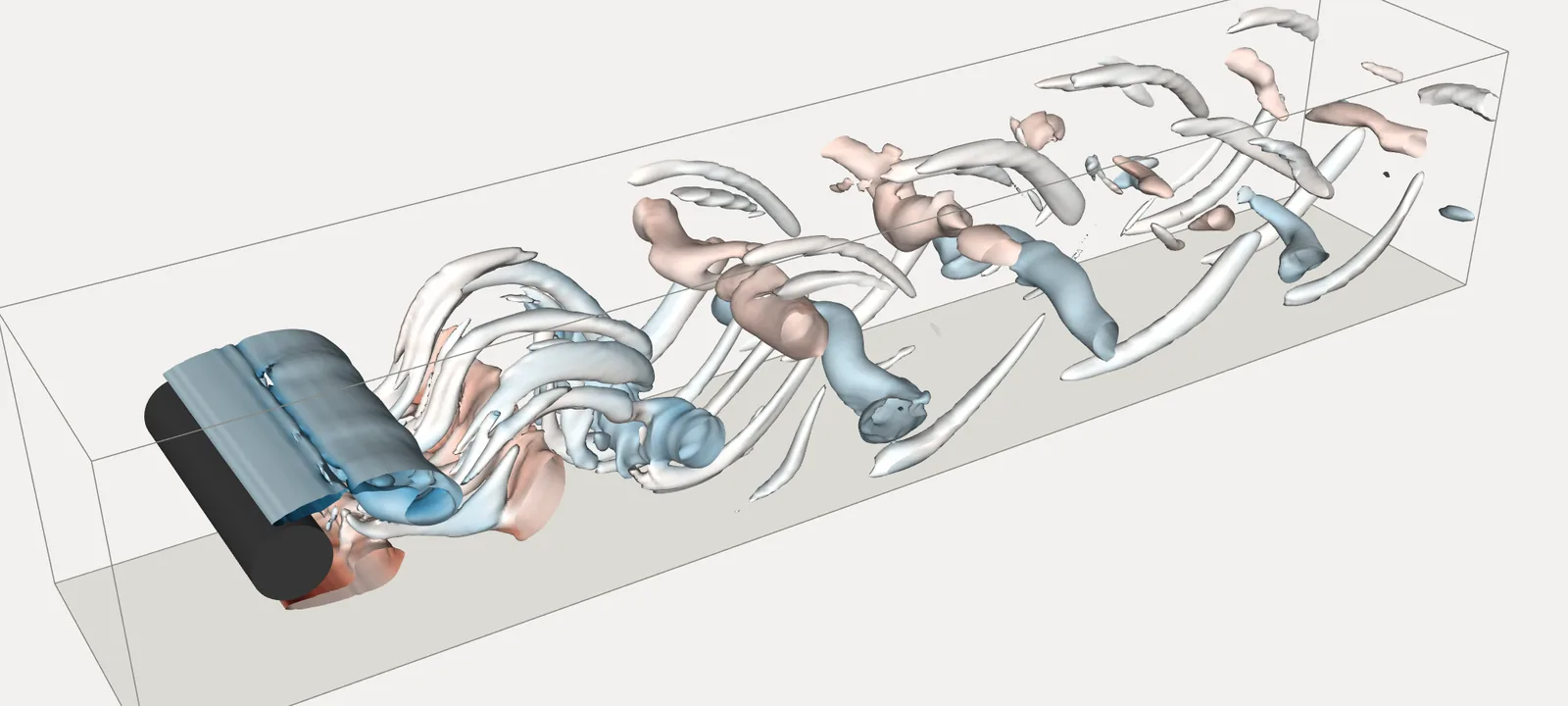
Cylinder in a Channel · O-grid, 2D and 3D
-
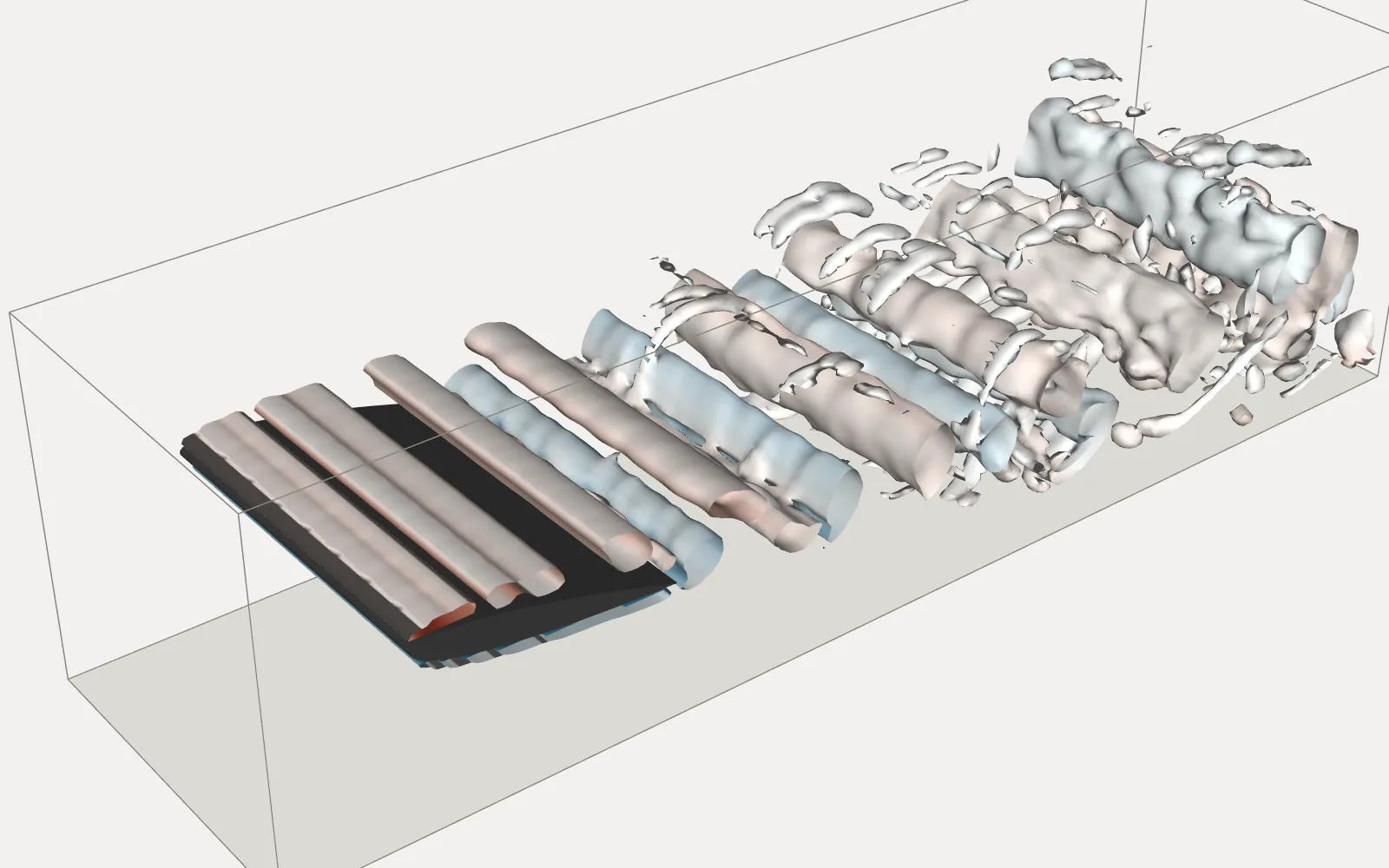
Airfoil in a Channel · 2D and 3D, Re = 3000
-
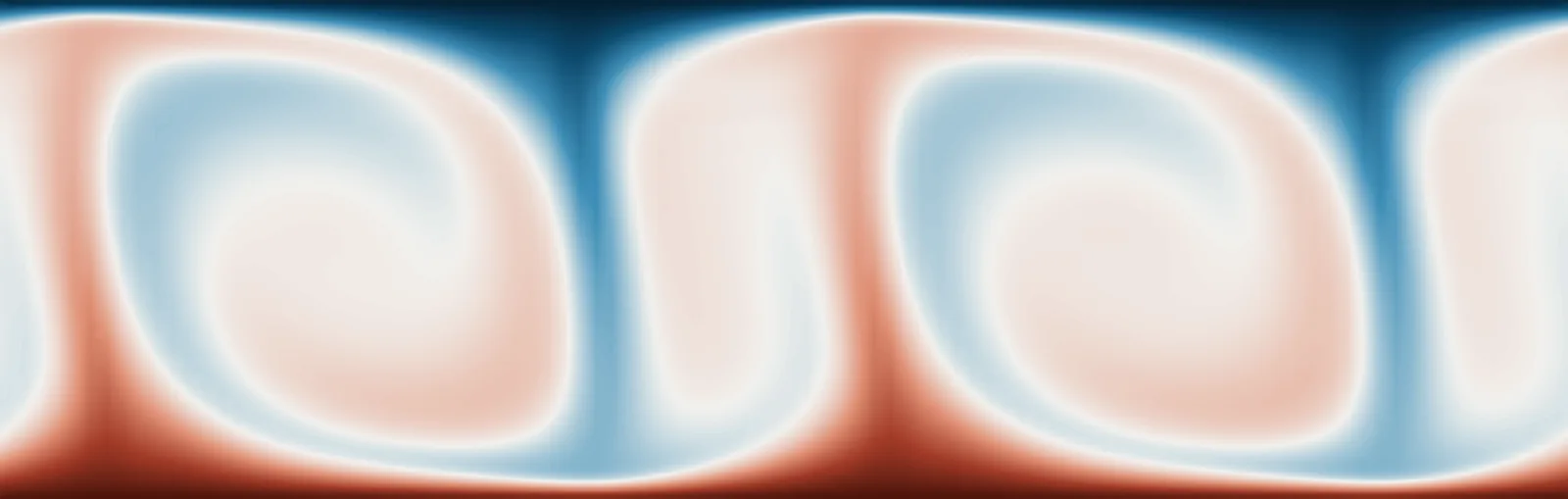
Rayleigh–Bénard Convection · 2D and 3D, Ra = 8·105
-
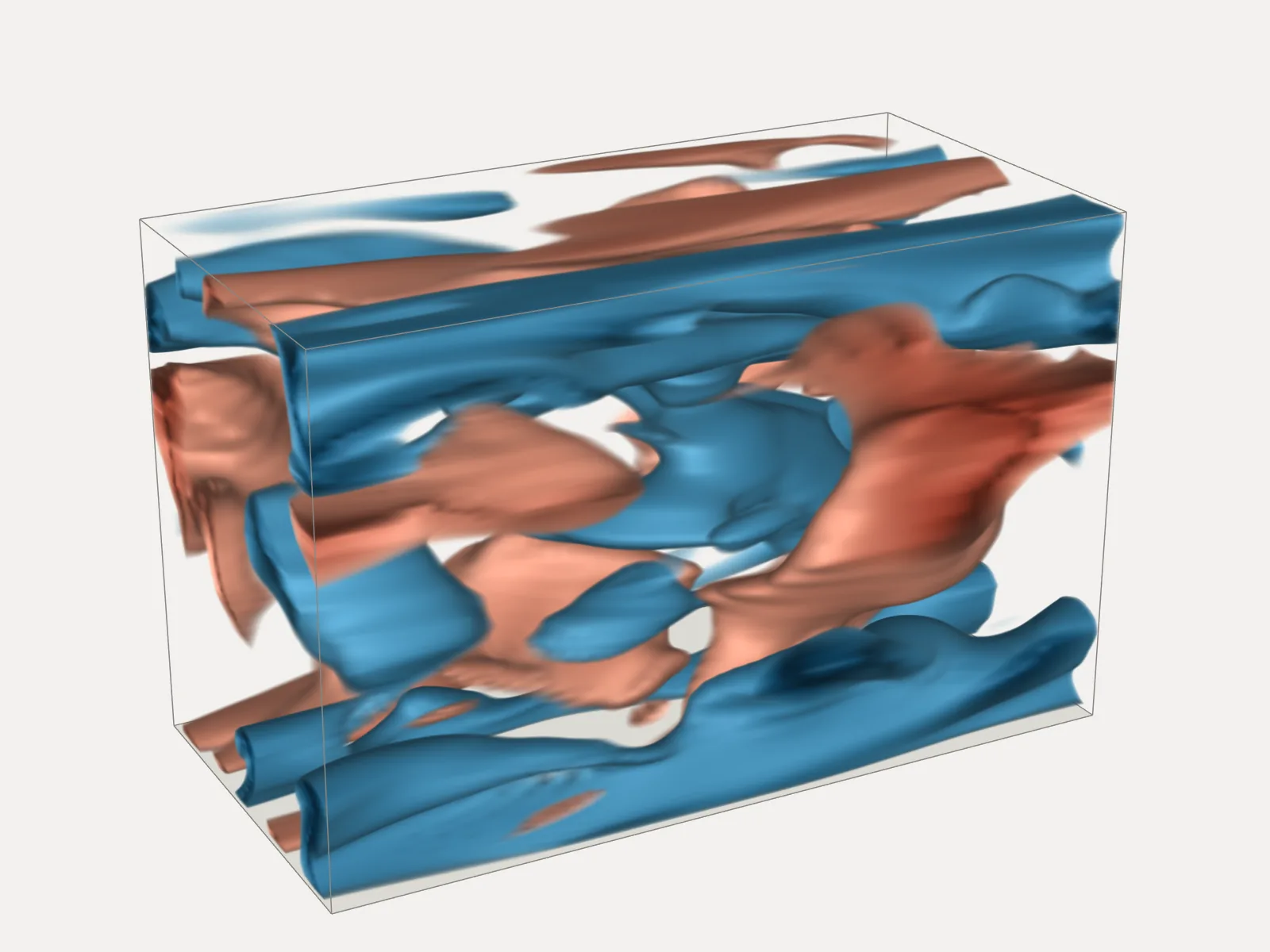
Turbulent Channel Flow · 3D, Reτ = 180
-
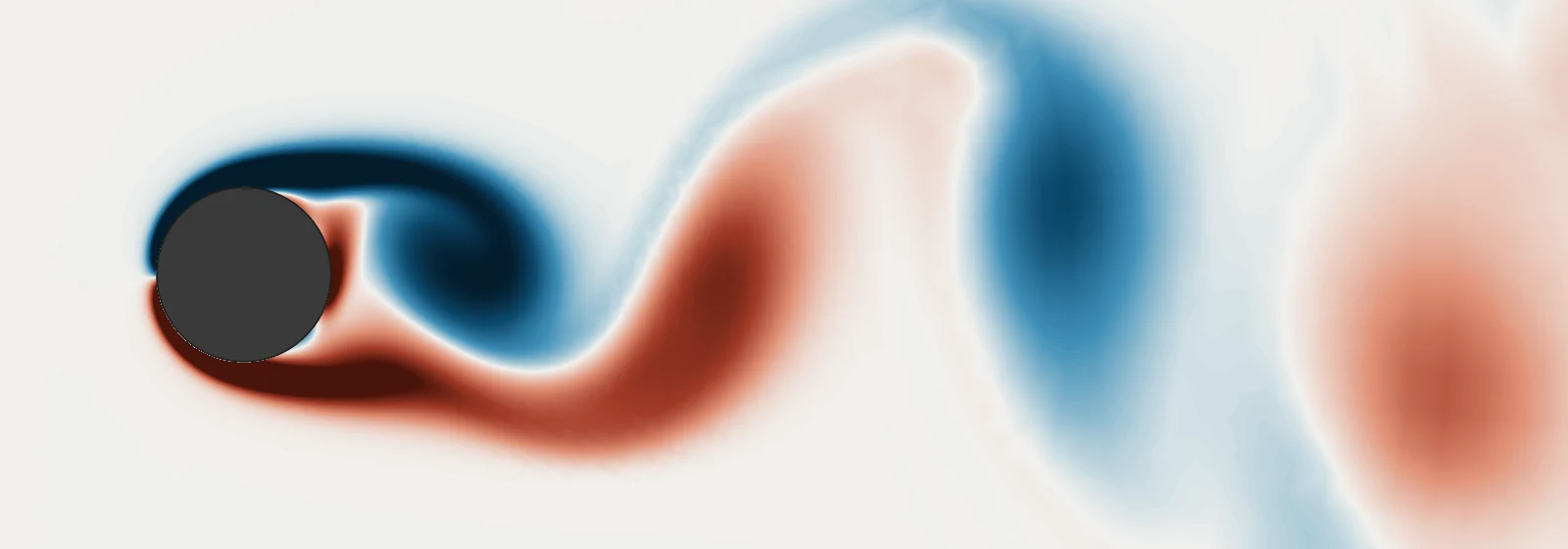
All examples · from the lid-driven cavity to learned turbulence models
Background¤
Many problems in fluid dynamics benefit from combining numerical solvers with machine learning: learned corrections for coarse simulations, turbulence closures, flow control and inverse problems. Training such hybrid models works best when the network sees the consequences of its outputs over many simulation steps. This requires a solver that is accurate, fast, and differentiable.
PICT provides this for incompressible flows:
- The forward solver. A finite-volume PISO solver on collocated, curvilinear multi-block grids, with implicit time integration, GPU linear solvers (CG and BiCGStab) and support for passive scalars and source terms. It is validated on lid-driven cavities, Poiseuille flow, a backward-facing step and a 3D turbulent channel flow, including against OpenFOAM on the same mesh.
- The gradients. Every operator of the PISO step has an analytic backward kernel, and linear solves are differentiated with adjoint solves. Gradient paths can be pruned to trade accuracy for speed.
- The learning interface. Fields are PyTorch tensors, networks are injected through callbacks, and multi-block convolutions operate seamlessly across block boundaries.
In the paper, PICT is used to train correctors for a 2D vortex street and a backward-facing step. It is also used to train a 3D sub-grid-scale model for turbulent channel flow from reference statistics alone. The resulting corrected low-resolution simulation is about 40× faster than OpenFOAM at higher resolution, while matching the reference statistics more accurately. Read more in Numerical Method and Results from the Paper.
Citation¤
If you find PICT useful for your research, please cite:
@article{franz2026pict,
  title     = {{PICT} -- A Differentiable, {GPU}-Accelerated Multi-Block {PISO} Solver for Simulation-Coupled Learning Tasks in Fluid Dynamics},
  author    = {Franz, Aleksandra and Wei, Hao and Guastoni, Luca and Thuerey, Nils},
  journal   = {Journal of Computational Physics},
  volume    = {544},
  pages     = {114433},
  year      = {2026},
  doi       = {10.1016/j.jcp.2025.114433}
}
(Feel free to also give the project a star on GitHub if you like it.)
Funding¤
This work was supported by the European Research Council (ERC-2019-COG #863850 SpaTe) and by the DFG Research Unit FOR 2987/1.
License¤
The PICT code is released under the Apache License 2.0. The paper is open access under CC BY 4.0.
PICT is developed by the Physics-based Simulation group at the Technical University of Munich · Other publications of the lab · GitHub @tum-pbs